Summary. The elusive unexplained aerial phenomena (UAP) often seen in our skies are not easy to study. They have been photographed, but the value of such images is generally thought to be suspect. Some have been shown to be hoaxes designed to fool people for various reasons. This article presents research showing that some images provide useful data that are unlikely to be found in hoaxed photographs. The UAP is often photographed next to a transparent toroidal pattern. Some image features imply that the pattern is caused by both gravitational and magnetic fields. The consistent spatial relationship between the UAP and the toroidal patterns suggests that the fields are created by the propulsion system of craft under intelligent control.
The presence of unexplained aerial phenomena (UAP) has often been documented in photographs since cameras have become generally available. A difficulty with such photographs is that they can be created by hoaxers. A photographer may claim that a photograph of an object suspended or thrown in the air is a UAP (see examples in Condon and Sullivan, 1969, Plates 7, 8, 47). If done well, the object may never be revealed for what it is. Therefore, photographic evidence of a UAP is generally considered unreliable. But such evidence may still have value. Examination of many photographs has uncovered a visual anomaly associated with UAP.
The anomaly is a toroidal optical distortion in the space beside the UAP. The presence of the anomaly in photographs taken over many years suggests that the UAP on those photographs are unlikely to have been hoaxed.
The anomaly is usually hard to see in the original photograph and is easily overlooked or interpreted as a natural element in the scene. When the brightness of the area of interest is not saturated, a simple image processing technique known as equalization can extend the visual range of intensities in the image and improve perceptibility of the anomaly. About 40 images containing the anomaly have been identified using this technique.
The visibility of a torus may be accentuated by its outline which ranges from diffuse to distinct. The surface of the torus may be the same, lighter, or darker than the background. Since the surface typically has the same texture as the background, it often appears to be translucent.
In the photographs, the optical distortion is interpreted as a projection of a three dimensional toroidal shape. A torus in the frontal plane is most easily detected, but those with other orientations have also been discerned. As the angle between the frontal plane and the plane of the torus increases from 0 to 90 degrees, the projection of the torus is an ellipse within an ellipse and finally an approximate rectangle. The projection can be more confusing when two tori intersect at an arbitrary angle. In spite of such occasional difficulties, the consistency of appearance and placement across images suggests that the optical effects are phenomena to be explained.
The toroidal patterns do not have a fixed size relative to the UAP. Some are small and some are very much larger. In most of the photographs, the UAP is observed to be on the torus, just inside or outside the boundary of the torus, but never at the centre. So the geometry may vary widely and is never symmetric around the UAP.
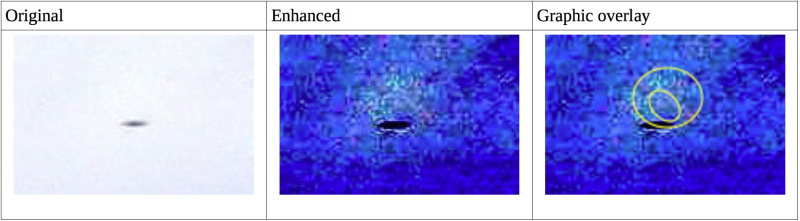
Some good examples are shown in the following figures. The left panel shows an object cropped from the original photo, the middle panel shows the image enhanced with equalization to increase contrast, and the right panel shows a graphic overlay marking the position of a torus.
| |
| Figure 1. Example of an optical distortion above a craft, Brazil, 2011 |
 |
| Figure 2. UAP photographed by Paul Villa, Peralta, NM, 1963 |
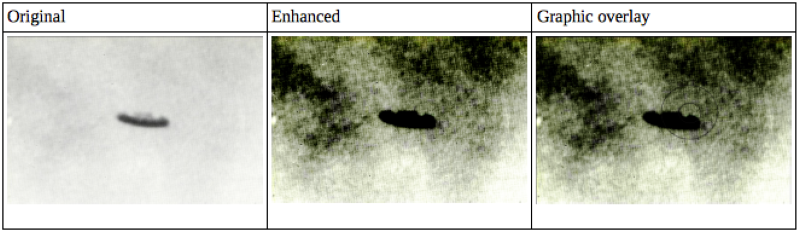 |
| Figure 3. UAP photographed over Torrance, California, 1967 |
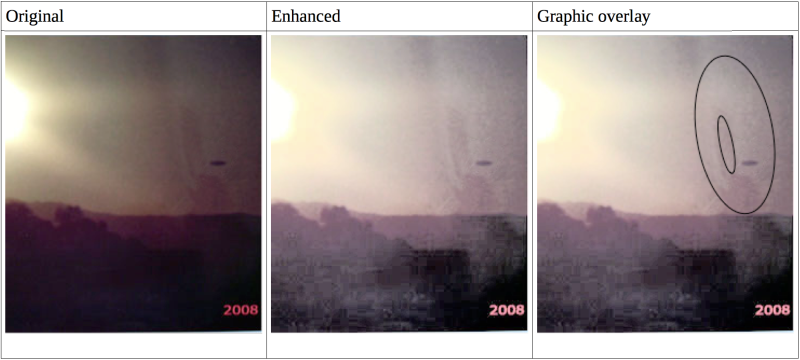 |
| Figure 4. UAP over North Canterbury, NZ, 2008 |
The object in the NASA Hubble Space Telescope image of Figure 5 was thought by NASA scientists to be the result of an unusual collision between two asteroids. It is included here because some of the supposed debris is organized in a partial toroidal pattern, suggesting that the oddly shaped feature seen in the image is in the same class as the UAP in the other photographs.
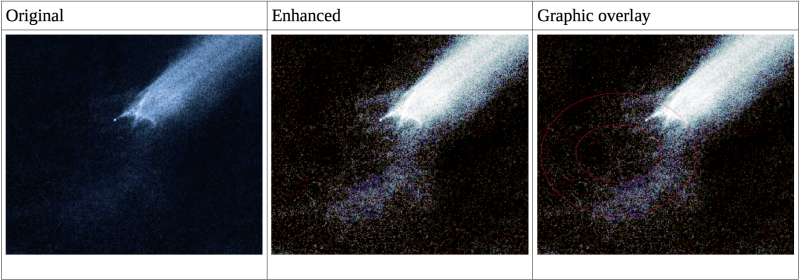 |
| Figure 5. UAP in a NASA Hubble Space Telescope image, 2010 |
In the image of Figure 6, a UAP is fortuitously positioned next to a rainbow. In the enhanced image, we see red light reflected from the right end of the supposed object. The nearest source of red light is the rainbow, so the red colour from the rainbow appears to be displaced to the left at the level of the object. A toroidal shape overlays the object at that point, and it may have something to do with the refraction of the red colour from the rainbow toward the object. Similarly, a strip of violet colour overlays the red colour of the rainbow at the top of the torus. Here, the rainbow colours appear to have been refracted to the right by the torus. Displacement of the rainbow colours in different directions suggests that the torus defines a region of space with a variable refractive index.
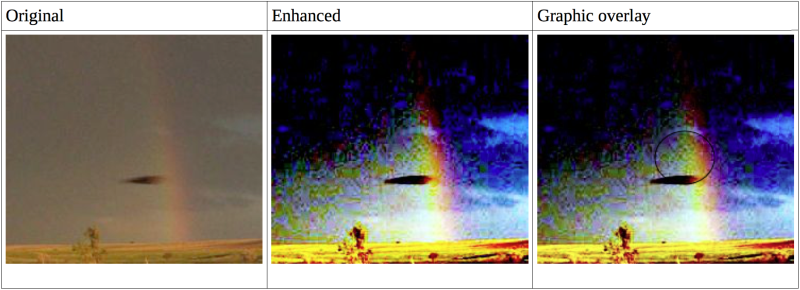 |
| Figure 6. Light refraction near a UAP over South Dakota, 2010 |
The UAP is most likely to be near or touching the torus in the images, implying that they are linked somehow. Perhaps the UAP is a craft, and the toroidal shape is an artifact created by the craft's propulsion system.
If the UAP are indeed craft, the discovery of a magnetic field where an unidentified craft had been is of interest. Maccabee (1994) reported that a craft had been observed to rise from the ground, flip over and remain visible for three or four seconds before it suddenly disappeared in a clear sky. He and a colleague arrived on the scene the next day and measured a strong magnetic field where the craft had been. The field pulsed at a rate of about 10 Hz and was strongest in the space above some trees. The unusual location suggests that space itself had been altered in some way to create the field. It persisted for many hours, presumably while the space gradually returned to normal after the craft had gone.
These images are examples of many that show a UAP accompanied by a toroidal pattern nearby. The torus is present under a variety of conditions, and so it is a robust phenomenon. It often has a simple, clearly-defined geometry, and so it is unlikely to be a natural phenomenon. Further, the consistent proximity to an apparent object suggests that the effect is produced by a technology associated with the object. It is not unreasonable to think that the UAP are craft under intelligent control.
The toroidal pattern is typically seen adjacent to a UAP inside the atmosphere, but as suggested in Figure 5, it may also exist in airless space. The partial ring of debris in Figure 5 may have been formed by the presence of a toroidal gravitational field with the field direction perpendicular to the boundary of the torus. Several other images show cloud material similarly shaped in the form of a torus. Such a gravitational field could also bend the path of light passing by it. Astronomers refer to this as gravitational lensing. The effect has been seen as an Einstein Ring (King et al., 1997) when the light source, gravity source, and observer are properly aligned. Perhaps diffuse ambient light from behind a craft's localized gravitational field would appear to an observer in front as a subtle ring near the craft.
The observed refraction of light by the torus in Figure 6 could be due to the strong magnetic field identified by Maccabee (1994). It might produce the Cotton-Mouton effect, a double refraction caused by the alignment in the field direction of magnetically anisotropic molecules in the air (Jenkins and White, 1957). The direction of refraction at the bottom of the torus was opposite to the direction at the top, suggesting that the effect depended on the direction of a magnetic field. A circular magnetic field in the vertical plane would have opposite field directions at top and bottom.
The evidence suggests that both gravitational and magnetic fields participate in the creation of the toroidal effect often seen beside UAP. A reasonable working hypothesis is that the fields are produced by the propulsion systems of unidentified craft. Chapter 3 of Treurniet(2021) argued that the toroidal anomaly is due to changes in the permeability of free space near a craft.
Condon, E.U. and Sullivan, W., Scientific Study of Unidentified Flying Objects, Bantam Books, NY, 1969. See also an online electronic edition published by National Capital Area Skeptics (NCAS), 1999.
Jenkins, F.A. and White, H.E., Fundamentals of Optics, McGraw-Hill, NY, 1957.
King, L.J., Jackson, N., Blandford, R.D., Bremer, M.N., Browne, I.W.A., de Bruyn, A.G., Fassnacht, C., Koopmans, L., Marlow, D., and Wilkinson, P.N. A complete infrared Einstein ring in the gravitational lens system B1938+666, Mon. Not. R. Astron. Soc., November, 1997.
Maccabee, B. Strong magnetic field detected following a sighting of an unidentified flying object, Journal of Scientific Exploration, 8(3): 347-365, 1994.
MERLIN Press Release PE9801, A bull's eye for MERLIN and the Hubble, MERLIN/VLBI National Facility, Manchester, UK, March, 1998.
Treurniet, W. A gallery of toroidal anomalies in UFO photographs [Online]http://www.treurniet.ca/tori/torigallery.htm.
Treurniet, W. An observed property of UAP in photographs, WISE Journal, Vol. 6(4):117, [Online]http://www.treurniet.ca/tori/torizeta.htm, 2017b.
Treurniet, W. C. Signs of a Multidimensional Reality.pdf, 2nd Ed., Copyright W.C. Treurniet, 2021.
Treurniet, W. C. and Hamden, P. The science of the Zeta race, Copyright Hamden & Treurniet, 2016.
Treurniet, W. and Hamden, P. A Primer of the Zeta Race, Ed. 17, Copyright Hamden and Treurniet,[Online]http://www.treurniet.ca/zetacom/zetaprimer.htm, 2022a.
Treurniet, W. and Hamden, P. Extraterrestrial Cosmology and Technology, Ed. 6, Copyright Hamden and Treurniet,[Online]http://www.treurniet.ca/zetacom/zetaprimer.htm, 2022b.